 English
 French

Minting 9JC Is Like Free Money — But There’s a Catch
Finance |
2026-08-14 06:46:01


Check your 9jawap wallet area to learn more
The hospital needed a doctor by 7 a.m. It was 11 p.m. The medical director made six calls. Two numbers were switched off. Three doctors weren't available. One said yes, then didn't show. By morning, a nurse was covering a ward she wasn't trained for. Nobody logged what happened. Nobody was accountable. This is not an unusual night in a Nigerian hospital. It is Tuesday.
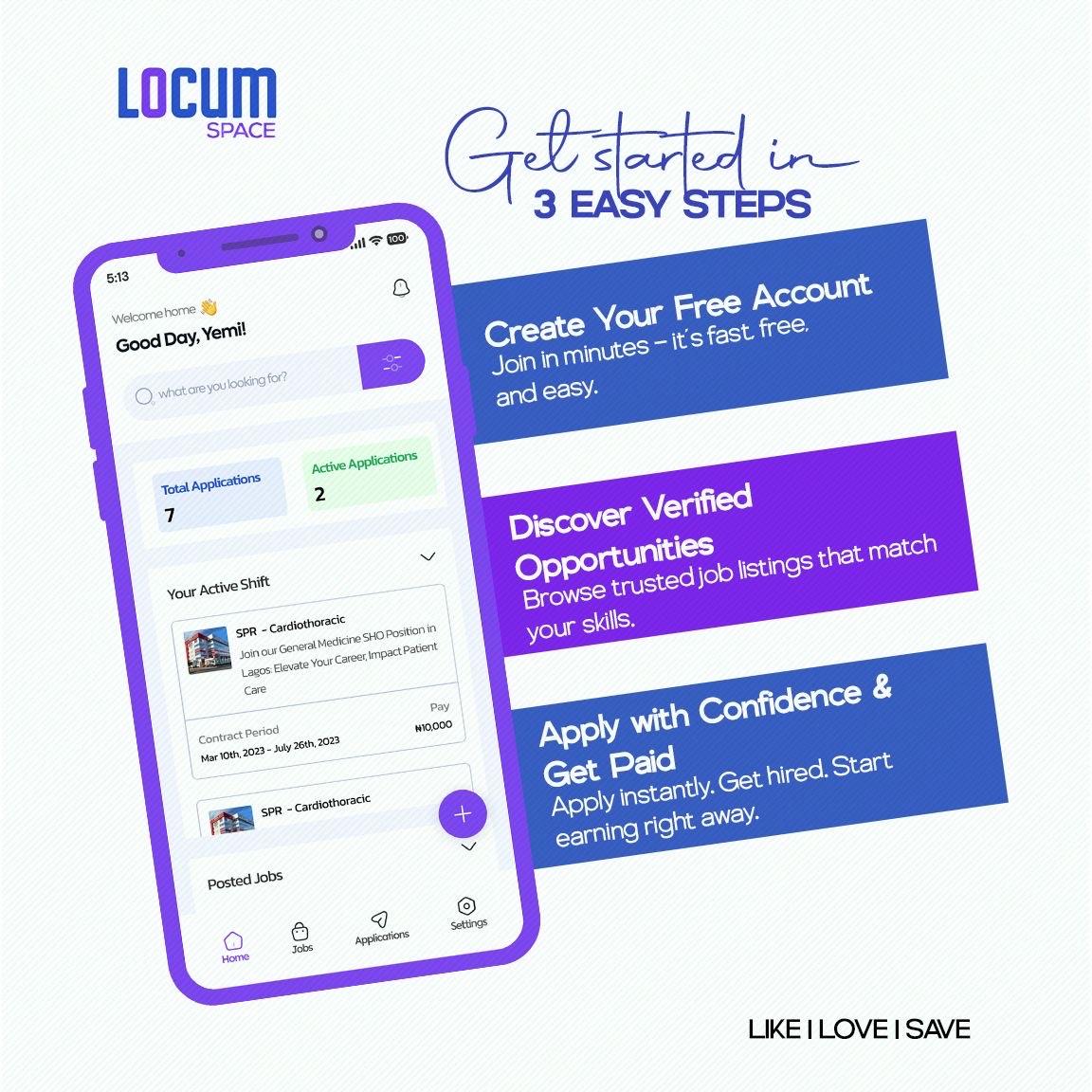
Locumspace was built for that medical director. Not for a future version of the health system, not for a post-reform Nigeria that doesn't exist yet, but for the one that does: under-resourced, relationship-dependent, and running on informal trust networks that work until they don't. The platform connects licensed health professionals with hospitals and clinics across Nigeria, replacing the phone tree with something that can be searched, verified, and booked in under ten minutes.
Visit locumspace.co to see what that looks like in practice.
Nigeria has approximately 40,000 registered doctors actively practising, against a population of over 220 million. The ratio is inadequate by any measure. But the staffing crisis in most hospitals on any given day isn't caused by a national shortage of doctors. It's caused by a mismatch: the right professional exists somewhere in the city, often available, often willing to work a locum shift, and completely unreachable through any formal mechanism.
The mechanism that exists instead is word of mouth. A department head knows a few doctors. Those doctors know a few more. The network has depth but no breadth, no verification, and no redundancy. When the usual contacts aren't available, the system fails. Not because doctors don't exist. Because no one built the infrastructure to connect them reliably.
The consequence shows up in bed occupancy rates, in delayed procedures, in nurses doing jobs that fall outside their training, and in patients who wait. It also shows up in doctors: qualified professionals who want to work locum shifts but can't find a dependable way to access them, spending time on phone calls and WhatsApp messages instead of patient care.
Locumspace is a credential-verified staffing marketplace. Hospitals post shifts. Verified health professionals apply. The platform handles identity verification, license validation against MDCN, NMCN, PCN, and MRTB registers, scheduling, and payment. What used to take six phone calls and a prayer takes a search and a booking.
The credential verification isn't a checkbox. It's the product. A hospital calling a doctor they found on WhatsApp has no way to confirm that doctor's registration status, no record of what shifts they've worked, and no mechanism to flag performance issues. Locumspace holds that record. The hospital books someone whose credentials have been confirmed, whose history on the platform is visible, and who has agreed to show up. The accountability is structural, not personal.
For health professionals, the platform resolves a different problem. Locum work in Nigeria is currently lucrative but opaque. Rates vary wildly. Payment reliability depends on who you know. Locumspace standardises the process: shifts are posted with rates, payment is processed through the platform, and professionals build a verified work history that travels with them. The informal system rewards relationships. Locumspace rewards reliability.
The platform covers all 36 states. The founding team, built from clinical and technical backgrounds, understands both sides of the transaction. CEO Dr Oluwatowo Fabiyi practised across Nigerian hospitals for four years before co-founding the company, which means the platform's design reflects what actually happens on a night shift, not what a pitch deck imagines happens. That distinction matters more than any feature.
Three things are converging. Nigeria's smartphone penetration passed 40 percent in 2024 and is still rising. The country's health system is under-documented, measurable strain, and the government knows it. And a generation of Nigerian health professionals has spent time working in health systems where digital infrastructure exists, returned home, and found that it doesn't. They're not waiting for it to appear. They're building it.
Locumspace sits at the intersection of all three. The professionals it needs are already online. The hospitals it serves are already understaffed. The regulatory bodies it integrates with already have the registers it needs to verify against. This isn't a market that needs to be created. It's a problem that needs infrastructure. The infrastructure is Locumspace.
The platform is currently in early-stage operations in Lagos. Expansion across the southwest is the immediate priority. The roadmap after that isn't speculative. It follows the infrastructure: every state where phone-tree staffing fails is a state where Locumspace works. That's all 36 of them.
The single thing that will determine whether Locumspace succeeds or doesn't isn't the technology. The technology works. It's trust.
A hospital administrator who has spent fifteen years building a personal network of reliable doctors has something Locumspace has to earn: the confidence that the stranger on the other end of the booking will actually show up, will be who they say they are, and will perform at the level the shift requires. The informal system is inefficient. It is not irrational. The people running it made it from necessity and refined it through experience.
Locumspace's answer to that isn't a feature. It's a track record. Every completed shift, every verified credential, every payment processed on time is evidence that the platform can be trusted more than the phone call it's replacing. That evidence accumulates slowly. It has to. The hospitals that come to Locumspace and find it reliable will tell the next hospital. The professionals who are paid on time and booked consistently will build their practice through the platform. Trust in a marketplace doesn't come from a product launch. It comes from the thousandth booking working as well as the first.
That's where the company is focused. Not the press release. The thousandth booking.
Hospitals and clinics looking to post shifts, and licensed health professionals ready to register on the platform, can get started at locumspace.co. For partnership enquiries and press contact: locumspace.co/contact.
About Locumspace
Locumspace is a Lagos-based digital healthcare staffing marketplace connecting credential-verified health professionals with hospitals and clinics across Nigeria. The platform integrates with MDCN, NMCN, PCN, and MRTB regulatory registers and operates across all 36 states. Founded by Dr. Oluwatowo Fabiyi (CEO), Adebiyi Temitope (COO), Olayemi Abimbola (CTO), and Adebayo Oritunmise (Design Lead).